Part 3: The Pair Selection Puzzle
Asking the right questions when you can't ask them all
Where We Left Off
Part 1 set up the problem: 237 pendants, pairwise comparisons. Part 2 covered TrueSkill—how tracks estimated appeal and tracks uncertainty.
Now the real question: which pairs should we actually compare?
The Explore-Exploit Problem
Twenty comparisons in, the app knows a few things:
- Pendant #47 (rose gold teardrop) has won 6 of 7 matches. Looking good.
- Pendant #183 has never been compared. Complete mystery.
- Pendant #12 has mixed results across 5 comparisons. Meh confidence.
What should we show next?
Option A: Exploit
Compare #47 against its closest rivals. Nail down the top of the ranking.
Option B: Explore
Compare #183 (never seen) against something. Maybe it's a hidden gem?
Classic exploration-exploitation tradeoff.[1]
Figure 1: The fundamental tradeoff. Pure exploitation might miss better options; pure exploration wastes comparisons on known mediocre items.
Too much exploitation → miss better options hiding in the unexplored pile.
Too much exploration → waste comparisons on stuff you already know is mediocre.
We need a principled way to balance.
The Obvious Ideas (And Why They Fail)
Random pairs: Just pick any two.
- ❌ Wastes comparisons on items we already understand
- ❌ Shows obviously mismatched pairs (uninformative)
- ❌ Repeats the same pair too often
Round-robin: Always compare items with the fewest comparisons.
- ✅ Every item gets exposure
- ❌ Doesn't care about match quality (#1 vs #200 teaches nothing)
- ❌ Ignores uncertainty—some items need more matches than others
Similar- heuristic: Compare items with close mean values.
- ✅ Close matches are informative
- ❌ Ignores uncertainty ()
- ❌ Gets stuck on the same competitive pairs
- ❌ Never explores new items
We need something smarter.
: Expected Uncertainty Reduction
Here's the insight from Bayesian active learning: pick the pair that teaches us the most.
But "teaches us the most" is vague. How do we measure it?
Answer: measure how much uncertainty will shrink.
For any pair (i, j), compute the expected —the expected reduction in total uncertainty after comparing them.
Where:
- is the outcome: Left wins (L), Right wins (R), Draw (D)
- is the probability of that outcome
- is how much uncertainty drops if that outcome happens
How to Compute It
TrueSkill gives us the tools. For pendants with ratings and :
Get outcome probabilities: TrueSkill predicts , , based on the gap and combined uncertainty.
Simulate each outcome: Run the TrueSkill update for each possible result to see what values would become.
Take the expectation:
Why It Works
This formula captures what we want:
| Situation | Why | |
|---|---|---|
| Both items uncertain | High | Lots of uncertainty to reduce |
| One item uncertain | Medium | Still something to learn |
| Both items well-known | Low | Not much uncertainty left |
| Close match (similar ) | Higher | Uncertain outcome = balanced learning |
| Lopsided match | Lower | Predictable outcome = less info |
No heuristics or special cases. The math just does the right thing.
Thompson Sampling: Randomness on Purpose
is great, but it's deterministic. Same state → same pair every time.
That causes problems:
- Gets stuck in loops
- Over-focuses on a small set of "most informative" pairs
- Misses items that would be informative with a bit more exploration
Enter Thompson Sampling, an algorithm from 1933 (!) that's still one of the best explore-exploit balancers we have.
How It Works
- For each pendant, sample an appeal value from its posterior:
- Sort pendants by sampled appeal
- Look at adjacent pairs in this sampled ranking
- Score those pairs by , pick the best
Why It's Clever
The sampling is the key:
High- items → wide distributions → samples bounce around wildly
Sometimes they sample high (top of ranking), sometimes low (bottom)
They naturally end up in more comparisons
Low- items → narrow distributions → samples stay consistent
They hold their position
Only get compared when they're actually competitive
Figure 2: High-uncertainty items have wide posterior distributions, causing their samples to fluctuate. This naturally leads to more exploration of uncertain items.
Thompson Sampling is a natural explore-exploit balance: uncertain items get explored, certain items only compete when relevant.
The Hybrid: Best of Both
Pure is too greedy. Pure Thompson is too random.
So we combine them:
if random() < 0.25:
    candidates = thompson_sample_pairs()  # Sample from posteriors
else:
    candidates = all_pairs()              # All O(n²) pairs

best = max(candidates, key=expected_sigma_reduction)
return best- 75% of the time: Greedy on all pairs
- 25% of the time: Thompson generates candidates, then picks the best
This gives us efficiency from the greedy approach, exploration from Thompson, and no loops.
Figure 3: The hybrid selection algorithm. 75% of comparisons use greedy optimization; 25% use Thompson Sampling to avoid local optima.
Cooldowns for Skips and Draws
One more thing: if you skip a pair or call it a draw, we exclude that pair from the next 2 rounds. Prevents annoying repeats while still letting informative pairs resurface later.
The Complete Flow
Putting it together:
Figure 4: The complete pair selection algorithm, from initialization through scoring and filtering.
Does It Actually Work?
I tested the hybrid approach on my 237 pendants.
Before (random pairs):
- 100+ comparisons before rankings stabilized
- Kept showing obviously mismatched pairs
- Top 3 kept changing after 80 comparisons
After (hybrid + Thompson):
- ~50 comparisons to stable top 10
- Pairs felt meaningful—close calls that were hard to decide
- Top 3 locked in by comparison #45
Every pair feels like it matters. No more wasted clicks.
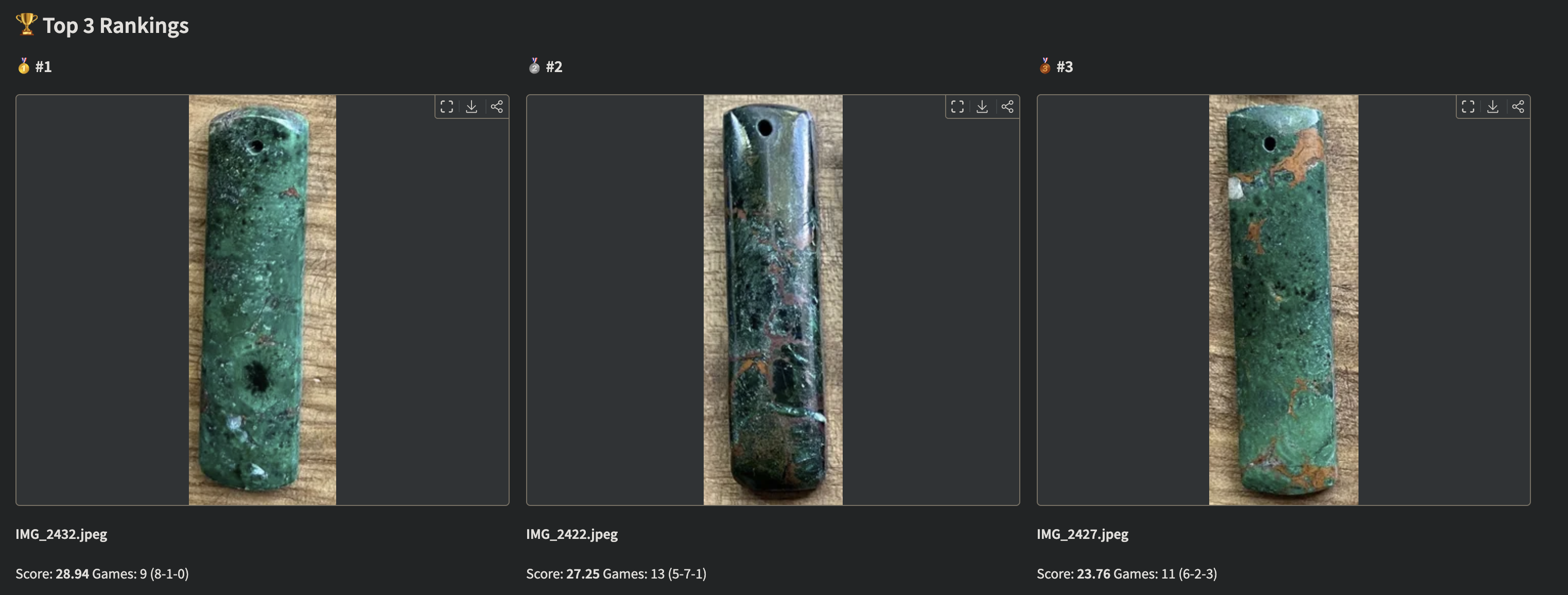
Figure 5: The final leaderboard, ranked by conservative score (). The top 3 are clearly separated with high confidence after just 47 comparisons.
Summary
is the gold standard for active learning in pairwise ranking. It directly measures expected information gain.
Thompson Sampling adds healthy randomness by sampling from posteriors, naturally balancing exploration and exploitation.
The hybrid (75% , 25% Thompson) combines their strengths.
TrueSkill does the heavy lifting.
quality_1vs1()andrate_1vs1()handle all the probabilistic reasoning.Cooldowns prevent annoyance. Nobody wants to see the same pair twice after skipping.
Epilogue
After 47 comparisons, the app converged. My top 3:
- 🥇 Rose gold teardrop with subtle diamond accent
- 🥈 Minimalist gold circle (surprisingly close)
- 🥉 Vintage-inspired cameo with modern twist
Went with #1. Valentine's Day was saved.
And somewhere in there, I learned more about Bayesian statistics than any textbook taught me. Sometimes the best way to learn is to have a problem you actually care about.
References
Source code: github.com/hugocool/product_picker
Previous: Part 2 - TrueSkill Demystified
Start from the beginning: Part 1 - The Pendant Problem
Sutton, R. S., & Barto, A. G. (2018). Reinforcement Learning: An Introduction (2nd ed.). MIT Press. The explore-exploit tradeoff is foundational in bandit problems and sequential decision making. ↩︎